
Early Childhood in Quebec: Build Fast, Retain Better
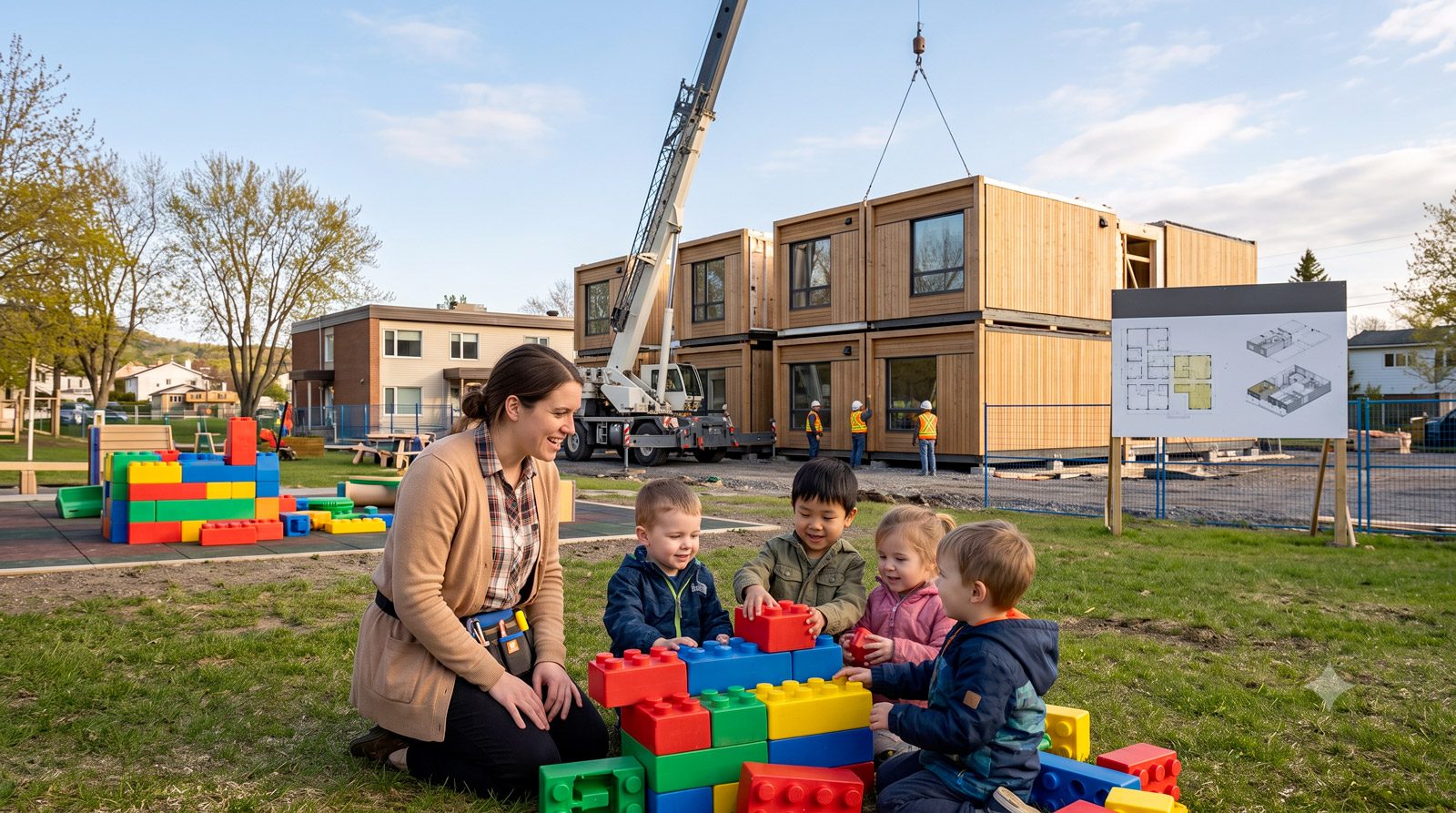
Quebec's early childhood network is going through a period of profound structural change. Between massive budgetary manoeuvres aimed at improving financial accessibility and the rollout of innovative modular infrastructure, the education landscape is being redrawn at a forced pace. Yet this physical expansion must not obscure a fragile social reality, one marked by persistent union tensions and historic closures. For managers and professionals in the sector, the challenge is no longer simply to build, but to stabilize the human capital that holds the entire structure together.
1. The Great Transformation: Massive Conversion of 5,000 Subsidized Spaces
The Fréchette government's recent announcement to convert 5,011 non-subsidized spaces into subsidized ones marks a major strategic pivot. By injecting nearly $400 million over five years, the government is not merely easing the financial burden on families; it is reshaping the competitive balance between sectors. This decision favours a model of direct funding to establishments, reducing the precariousness of private daycares while responding to parents' clear preference for the flat rate.
Analysis of the regional rollout: territorial equity in question
The call for projects selected 74 daycares, eight of which will fully switch to the Early Childhood Centre (CPE) model. While the metropolitan area and its surroundings capture a large share of the projects, a territorial analysis reveals blind spots — notably in Lac-Saint-Jean, where no establishment was selected despite pressing needs.
Administrative RegionSelected EstablishmentsRegional Specifics
Montréal- 35 projects - Includes 4 conversions to CPE (e.g., L'Enfanthèque)
Montérégie - 14 projects - Includes the strategic conversion of Garderie de l'Île aux Noix
Laval - 7 projects - Concentrated in high-density areas (e.g., Les amis de Zizou)
Laurentides - 4 projects - Large-scale projects such as Caroline et ses amis (80 spaces)
Lanaudière - 4 projects - Focus on stability (e.g., Garderie des journées magiques)
Saguenay - 4 projects - No project selected in Lac-Saint-Jean
Outaouais - 3 projects - Priority given to large establishments (Mon Petit Cosmos)
Centre-du-Québec - 3 projects - Crucial rescue of Académie Les p'tits Bonzaï
Toward financial and human sustainability
For families, the impact is immediate: at Garderie Nature in Chicoutimi, the daily rate drops from $70 to $9.65. The real gain, however, is organizational. Integration into the subsidized network allows managers to offer better working conditions, including access to a pension fund for educators. That is a powerful retention argument in a hyper-competitive labour market. The case of Académie Les p'tits Bonzaï in Bécancour, which saves 60 spaces from closure by becoming a CPE, shows how conversion can act as a bulwark against the collapse of local services.
While this financial shift shores up the network's budgetary foundations, physical expansion is also accelerating through architectural innovation.
2. Tomorrow's Infrastructure: Prefabrication and New Construction Sites
Faced with urgent demand, the Ministry of Families, under the leadership of Catherine Blouin, is betting on shorter construction timelines. The move toward prefabricated construction is becoming the norm as a way to sidestep the heavy traditional tendering process and the uncertainties of conventional building sites.
The modular model: from Gaspé to all of Quebec
The opening of CPE Les Vire-vents in Gaspé (100 spaces, including 25 for infants) marks a milestone: it is the first establishment of its kind in the Gaspé region and the third in Quebec. For executive director Gilles Chapados, the advantage is undeniable: by coordinating the project with Habitation Mont-Carleton, the administrative burden is drastically reduced. This successful pilot paves the way for other modular projects already planned in Bonaventure and Sainte-Anne-des-Monts.
Regional momentum and workforce challenges
At the same time, traditional construction sites are moving forward:
- Très-Saint-Rédempteur: The municipality's first CPE (Les Tourterelles, 42 spaces) is taking shape under the direction of Patricia Ringuette and project manager Claire Labrecque.
- Saint-Jean-Port-Joli: Construction has begun on CPE Les Coquins (62 spaces, including 30 for infants), a $3.6 million investment.
But a modern building is nothing without staff. In Gaspé, the opening requires the immediate hiring of 15 qualified educators. The paradox is striking: technological innovation can speed up the delivery of the walls, but it cannot offset the erosion of human capital without an aggressive strategy to raise the profession's standing.
This tension between physical development and the workforce crisis is currently crystallizing in an increasingly volatile social climate.
3. Social Climate and Instability: The Network's Paradox
The early childhood network is living through a contradiction: on one hand, thousands of new spaces are being announced; on the other, unprecedented structural cracks are appearing.
The Val-d'Or shockwave
The permanent closure of CPE Abinodjic-Miguam in Abitibi-Témiscamingue is a troubling historic first. The bankruptcy of this establishment means the outright loss of 80 spaces and 19 jobs. For the FSSS-CSN, it signals a lack of vigilance on the ministry's part in preserving existing gains. This "leaky bucket" of public management raises a fundamental question: how can expansion be promised while regional pillars are left to collapse?
Litigation and the convergence of struggles
In Saguenay–Lac-Saint-Jean, the dispute at CPE Le Jardin de Robi (Roberval) has now dragged on for four months. The issue of paid meal breaks has become the critical friction point that could set a national precedent. The situation is growing more political with the arrival of Christine Fréchette, a contender for the CAQ leadership, who was met in Alma by a united front of educators and paramedics. This convergence of union struggles places the early childhood file at the heart of the political contest, even as the FSSS-CSN denounces an attempt to curtail the right to strike by classifying CPEs as essential services.
Despite these pockets of turbulence, community solidarity continues to serve as an indispensable lever of resilience.
4. Community Vitality: Local Support
Beyond state subsidies, the network still relies heavily on local engagement to provide high-quality living environments. The success of the 32nd edition of McHappy Day in Mont-Laurier, which raised $55,200 for CPE La Fourmilière, illustrates the staying power of private support.
These funds, drawn from grassroots mobilization and local partners, help finance qualitative "extras" — play areas, specialized equipment — that government operating budgets do not always cover. They reflect the community's deep attachment, acting as a vital safety net in the face of institutional limits.
Conclusion: Outlook for Professionals
July 2026 sketches a horizon where opportunity sits alongside vigilance. For managers and practitioners, three lines of reflection stand out:
- Tap into new employment hubs: The rapid rollout of modular infrastructure in the Gaspé region and the construction projects in Montérégie are creating immediate demand. This is the moment for professionals to negotiate favourable terms.
- Stay vigilant on social gains: The dispute over paid meal breaks in Roberval is a warning sign. An unfavourable legal outcome could weaken working conditions across the entire network.
- The positive impact of conversion: The transition to the subsidized model financially stabilizes establishments and should be used as a lever to improve retention through benefits such as pension funds.
Despite the challenges, the current transformation confirms one thing: the early childhood educator profession has never been more central to Quebec's economic and social discourse. Recognition is underway, but stability has yet to be won.